LiFePO4 Safety-Oriented Chemistry
LiFePO4 is positioned for long-life stationary storage, data center UPS backup and residential/C&I ESS where thermal stability, cycle life and predictable degradation are core selection factors.
Battery Products & Technology | R&D Capability Showcase
Dragon Carp presents Sacred Sun / FNS Power battery technology through a practical engineering lens: cell chemistry selection, BMS protection, module and rack design, ESS integration, laboratory validation, and compliance pathways for residential, C&I, telecom and data center backup power.
Based on the supplied technology and R&D showcase materials, the page now organizes Dragon Carp’s battery offering around the engineering capabilities buyers need to evaluate: chemistry, system architecture, testing depth, manufacturability, safety design and application fit.
LiFePO4 is positioned for long-life stationary storage, data center UPS backup and residential/C&I ESS where thermal stability, cycle life and predictable degradation are core selection factors.
BMS architecture supports cell balancing, over-voltage, under-voltage, over-current, short-circuit and temperature protection, with communication interfaces for system monitoring and project integration.
Thermal pathways, cabinet airflow, temperature sensing and system derating logic help control battery operation under high-density backup and energy storage duty cycles.
Product families can be configured as rack-mounted modules, wall-mounted or stackable residential systems, high-voltage strings, outdoor cabinets and containerized ESS.
The R&D showcase materials emphasize clean production, automated equipment, lab testing and quality inspection as the foundation for repeatable battery performance.
System selection considers load profile, backup duration, inverter/UPS compatibility, communication protocol, installation environment and local certification requirements.
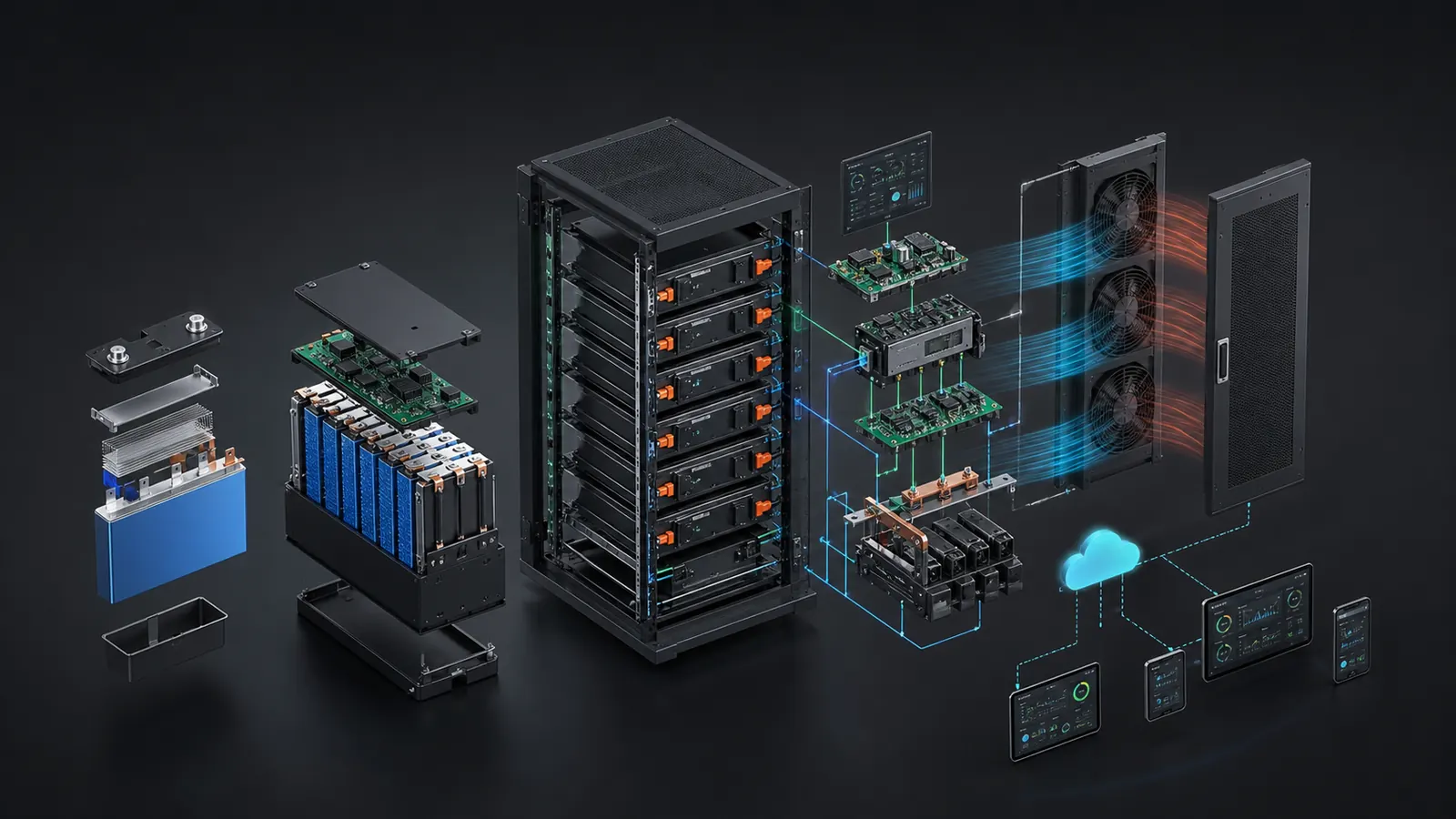
A practical ESS is not only a cell pack. It is a layered system where electrochemistry, power electronics, communication and thermal design work together.
The R&D content is translated into an engineering validation path that helps project owners understand how battery systems are selected, tested and prepared for deployment.
Define load profile, backup duration, installation environment, communication needs and certification targets.
Check capacity, internal resistance, consistency, cycle behavior and safety-oriented chemistry fit.
Validate charge/discharge behavior, efficiency, balancing strategy, high-rate response and protection thresholds.
Assess operation under temperature variation, cabinet heat load, humidity exposure and site-specific conditions.
Confirm BMS communication, inverter/UPS compatibility, monitoring logic, installation documentation and handover data.
The page now makes the technical proof visible: what is tested, what standards matter, and what project owners should verify before selecting a battery product.
Use this section as a buyer-facing map of the battery product families that can be configured for different energy storage scenarios.
Low-voltage stackable or wall-mounted LiFePO4 battery systems for solar self-consumption, whole-home backup and time-of-use energy shifting.
Cabinet and containerized systems for peak shaving, backup power, PV integration and operational resilience in commercial facilities.
Rack-mounted battery modules and high-voltage battery strings for critical backup power, compact installation and monitoring integration.
Battery modules, BMS, rack structures, DC protection, monitoring and documentation support for project configuration.
These external references are included to strengthen technical authority and help buyers understand the scientific and compliance context behind battery system selection.
Internal links help users and search engines connect product technology with application pages, project support and quotation workflows.
Short answers are added for search visibility and buyer clarity.
LiFePO4 is valued for thermal stability, long cycle life and predictable performance, making it suitable for residential ESS, C&I storage and UPS backup applications where safety and service life are central buying criteria.
The BMS monitors voltage, current and temperature, manages cell balancing, protects against abnormal conditions and communicates with the inverter, PCS, UPS or monitoring platform.
Project teams typically review cell consistency, electrical cycling, temperature performance, mechanical integrity, BMS fault response, communication compatibility and applicable standards such as UL, IEC and UN transport tests.
The correct product depends on voltage platform, backup duration, peak power, installation environment, communication protocol, inverter or UPS compatibility, certification needs and expected maintenance model.
Send your voltage, capacity, runtime, inverter/UPS model and installation environment. Dragon Carp can help map the correct Sacred Sun / FNS Power product pathway.